Most of my work happens where nobody can see it. As a backend developer I build the plumbing behind software: data goes in, data comes out, and if I do my job well, nobody notices a thing. Very satisfying. Not very easy to show at a birthday party.
So at the end of 2024 I wanted to build something you can actually see. Something you can walk around in. A game.
This is part 1 of the Floef & Wiks story: how it started, how it started over, and how two corgis ended up in charge.
Why a game, and why Godot
I have built websites and I enjoy that, but a game comes with a whole new set of mechanics: physics, cameras, levels, and things that fall over when they really should not. That was exactly the appeal.
I picked Godot as my game engine. A game engine is the toolbox that handles graphics, physics and input, so you can focus on the game itself. Godot is free and open source, and so is Blender, the 3D modelling tool I would need later on. Godot also has its own scripting language, GDScript, which reads a lot like Python. I already know Python, so learning game development did not mean starting from zero. It felt more like moving to a new city where they happen to speak your language.
Hue Hunt: one cube, one plate
I wanted to make an adventure puzzle game. What kind of adventure puzzle game? No idea. So in January 2025 I started a Udemy course on Godot to learn the basics. Along the way I learned something about myself as well: I work best when the concept is tiny, and I add to it one step at a time.
So the first concept was tiny. I called it Hue Hunt: find a cube, carry it to the plate with the matching color, level complete. That is the whole game.
I used the free Godot demo character, a little blue robot, and built a world out of plain grey blocks to walk around in. Game developers call this greyboxing: you build a level from simple shapes first, so you can test whether it is fun before you spend hours on how it looks. Think of it as a pencil sketch before the paint comes out.
My first greybox world was waaaay too big. The robot could walk for ages without anything happening, which is realistic, but not much of a game. So I made the levels smaller, added the mechanic to pick things up, and placed the finish plate.
The plan was 10 practice levels. I made 7. By then I had the hang of it, and I noticed I was really missing something: characters. A robot carrying cubes around is fine, but it is hard to care about.
Proto_game: the month of everything
Hue Hunt was full of test bits I no longer needed, so I started over with a clean project: Proto_game. It was also the first version I pushed to GitLab, on 24 January 2025. Looking back at the commit history, I clearly had some energy that month. On day one alone it got a victory screen, a checkpoint and a working button.
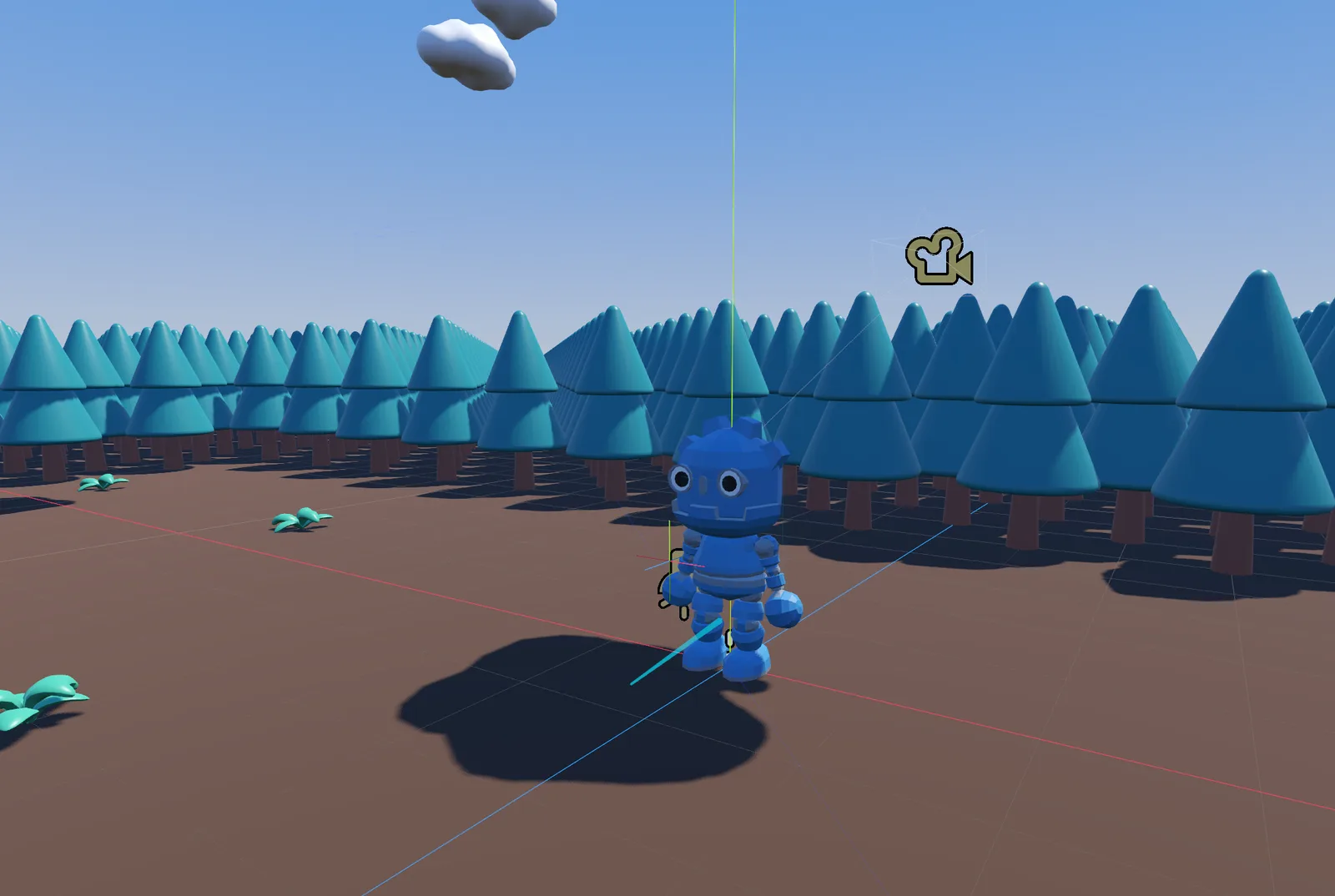
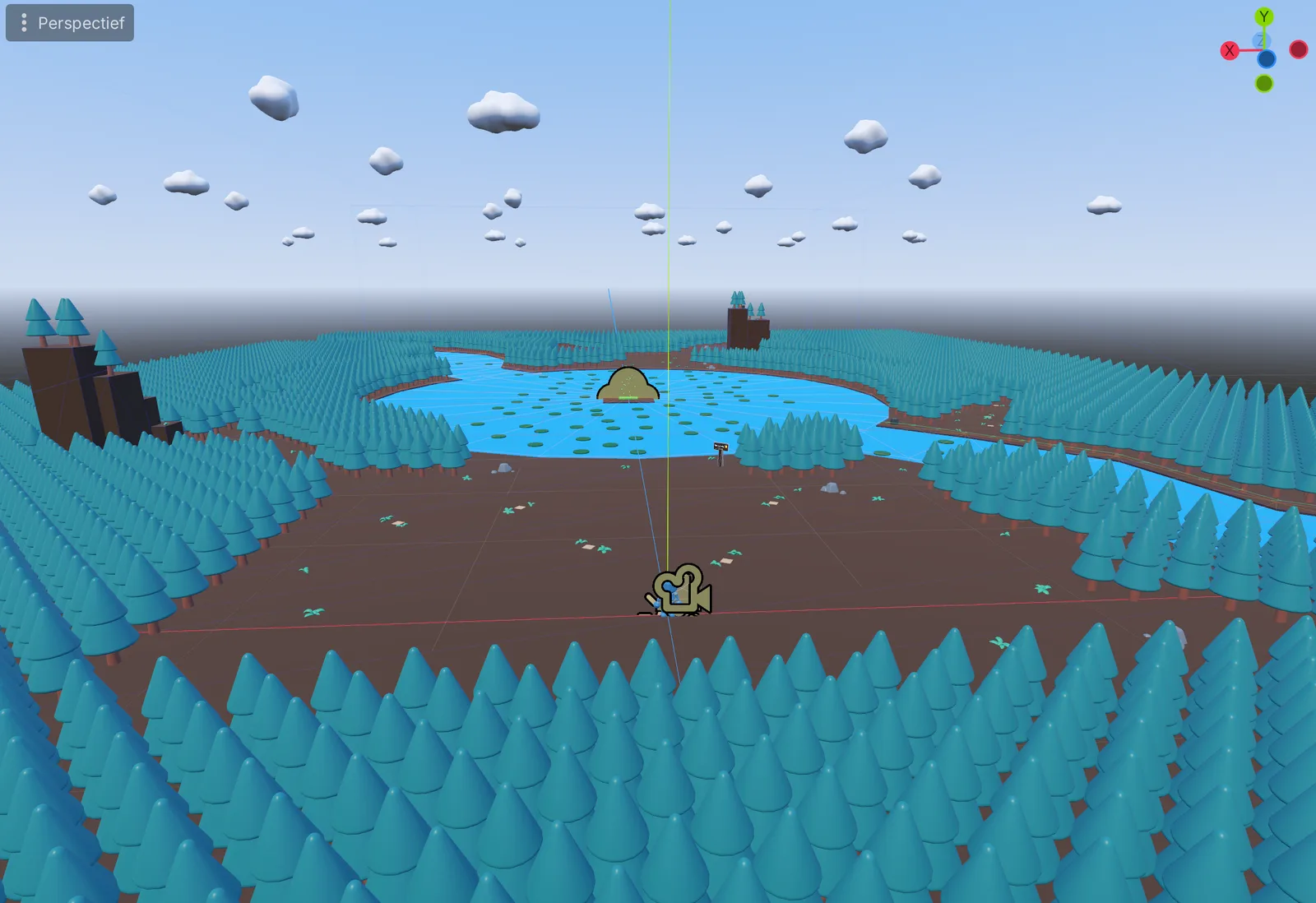
In about a month Proto_game grew into seven forest areas, some by day and some by night, with three tutorial levels to ease you in. The puzzles were built from a growing box of parts:
- Buttons you activate by putting an item on them
- Moving platforms, some of them started by a button
- Floating logs to hop across the water
- Lily pads that sink when you stand on them, and sometimes come back up
- A throw mechanic, for throwing floaties in the water to get to the other side
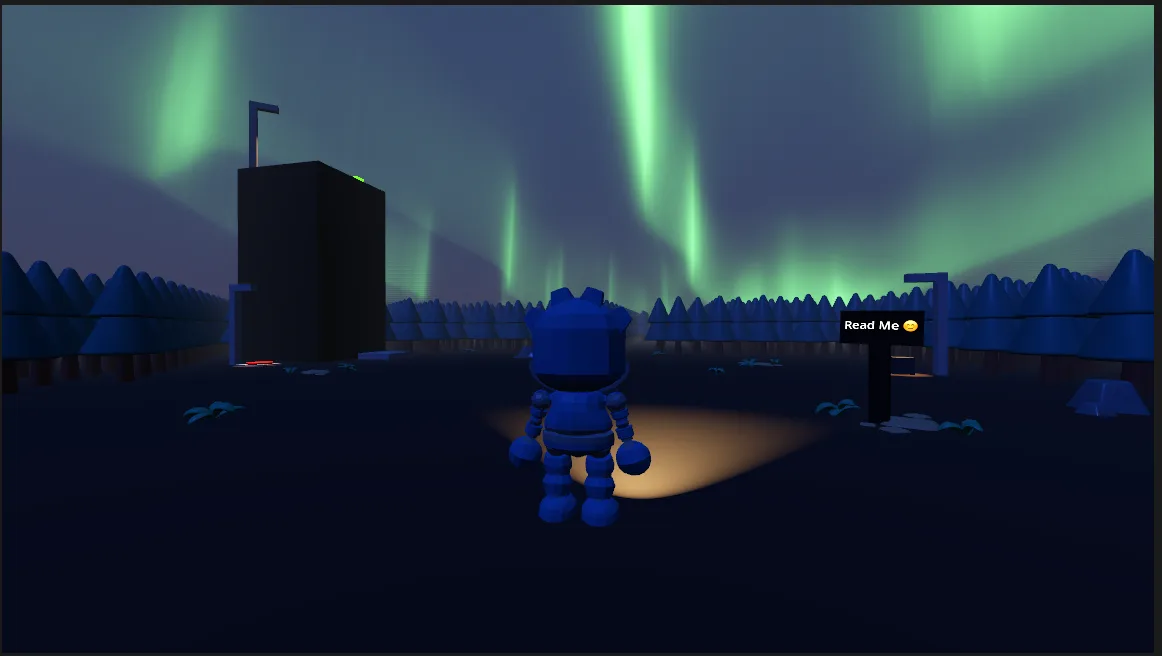
- A flashlight for the night levels
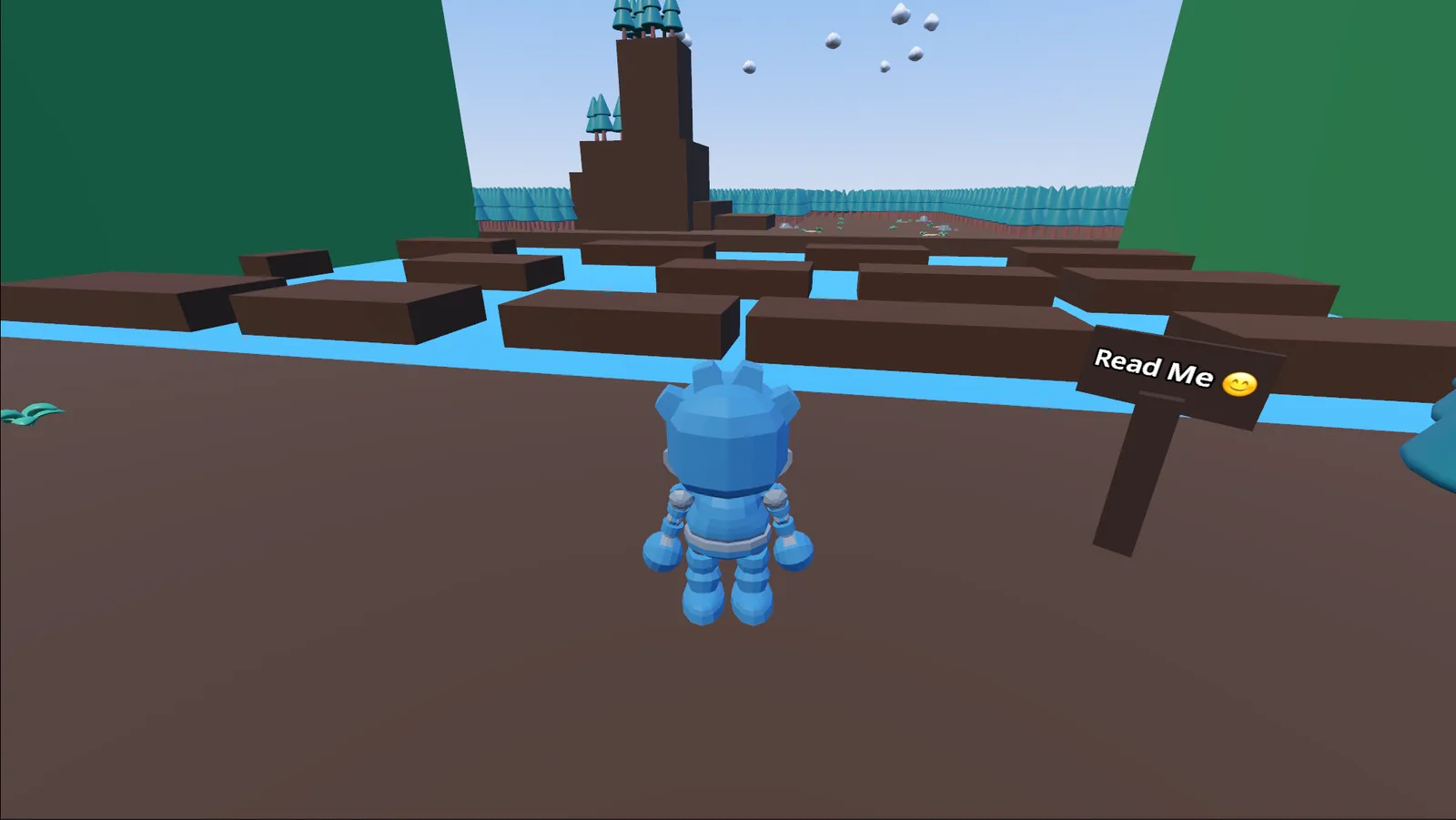
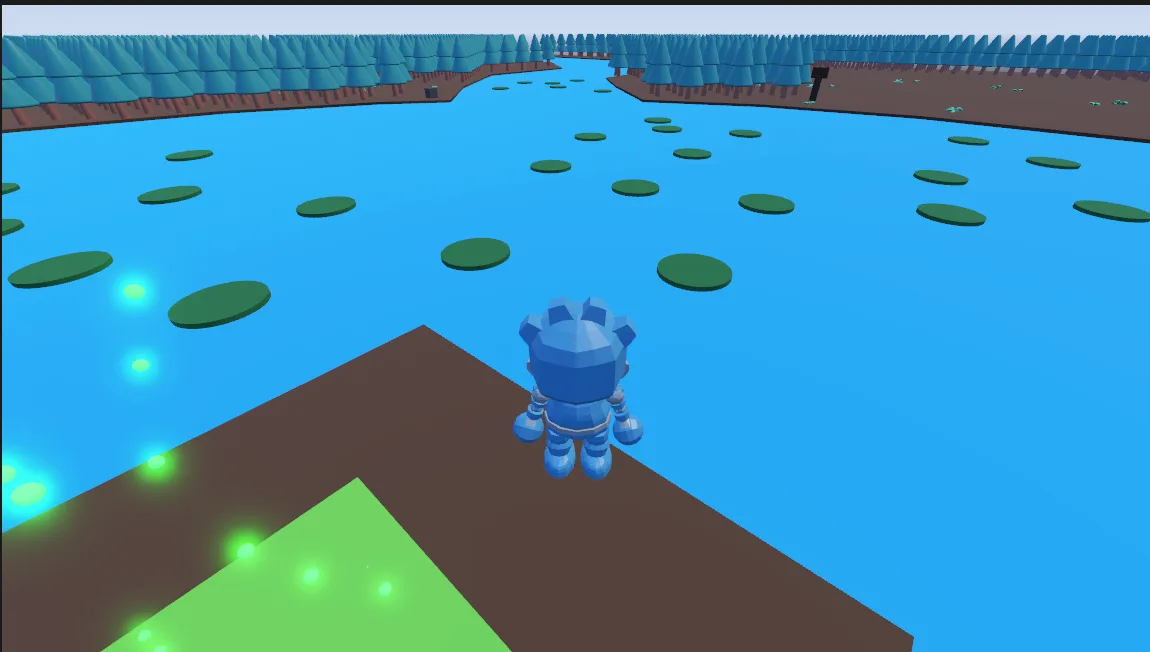
The night level is still my favorite: a little robot with a flashlight under the northern lights. Not bad for someone whose usual output is JSON.
Life happened
And then, for most of 2025, the commits stop. Life happened. We remodelled part of the house, moved our photo studio out of it, rethought our photography business, and took some time off together to recharge after a rough start to the year. The game waited patiently. Game files are good at that.
Meet Mr. Wiggle and his mom
That rough start had a name: Mr. Wiggle. He is one of our two corgis. Around the turn of 2024 to 2025, when he was one and a half years old, he had an intussusception: a part of his intestine had slid into itself, like a telescope folding shut. The vet removed 41 cm of his intestine in an emergency surgery. His recovery took a long time, and for a while we were not sure he would make it.
After the operation some of the problems came back. Further investigation showed that he has a permanent infection in his intestine, and he will be on prednisone for the rest of his life. So every time he has a bad day, our stress levels go up fast and we act straight away. But he is doing okay now, and he just turned three.
Going through all that made one thing clear to me: this game had to be named after our dogs. Floppy is the mother, Mr. Wiggle is her son, and their nicknames, Floef and Wiks, became the title.
The name changed the game, too. Hue Hunt was about finding cubes. With two corgis as the heroes, the idea grew: worlds that change not only in setting but in place (we could take it to the moon if we wanted to), and two players solving puzzles side by side, helping each other out along the way. That is not a hunt anymore, that is a quest. So Hue Hunt became Floef & Wiks: Hue Quest. As a bonus, the name leaves room for another “Floef & Wiks” adventure one day. Not on the roadmap, but the door is open.
What I learned so far
- Start tiny. One cube and one plate taught me more than a big design document would have.
- Greybox first. Plain blocks show you very quickly that your world is way too big.
- Give it a heart. The project only really came alive once it was about something I care about.
What’s next
Floef comes first. She is the most common corgi color there is, so there is plenty of reference material, even as ready-made 3D assets. Wiks is a mix, which makes him a bit more work on custom coloring and texturing.
I used AI tooling to create a first low-poly model of Floef, which is what I have in Blender today. But the AI started to mess things up. So in July 2025 I started a Blender course on low-poly worlds and characters. It also teaches proper rigging: building the skeleton that makes a model move. That part matters, because most automatic rigging tools assume either a human or a four-legged animal. Not a corgi who walks on her hind legs and actually uses her tail. For this project AI is a helping hand, not my co-author: this will not be a vibe-coded game.
Once Floef is done, the world gets the same cozy low-poly look, the seven levels get remodelled to match her style, and three new levels make it an even ten.
In part 2 I will show how Floef went from an image to a 3D corgi, and why she needs a skeleton of her own.